How to Use CBD in Bath and Beauty Products
Kayla Fioravanti is a founder and the head formulator at Ology Essentials, a research driven company dedicated to providing high quality CBD and natural skincare products. As an expert in the field, Kayla has joined us to talk about the use of CBD in skincare and how to incorporate it into your own products.
Highlights
-
CBD works in skincare because the body's endocannabinoid system has receptor sites throughout the skin that interact with topically applied cannabidiol.
-
Fat, heat, and proper measurement in milligrams per milliliter are essential to successfully incorporating CBD into any formula.
-
Leave-on products like lotions, salves, and creams are the most effective CBD delivery method since wash-off products offer little absorption benefit.
-
CBD should never be added to cold-process soap because lye converts it into a water-soluble salt that the skin cannot absorb effectively.
-
Selling CBD products comes with significant business hurdles, including banking restrictions, social media shadowbanning, and platform bans on major marketplaces like Amazon and Etsy.
What is CBD and the Endocannabinoid System
CBD is the acronym for cannabidiol (sounds like ka·nuh·buh·dai·uhl) which is a cannabinoid naturally occurring in cannabis plants. In fact, cannabis plants produce over 85 cannabinoids including CBD, THC, CBG, THCV, THCa, CBDV, CBC, and CBN.
Hemp produces a high level of CBD and a low level of THC. By legal definition, CBD can contain 0.3% or less THC as measured in the dried flowering portion of the plant.
CBD works topically because the endocannabinoid system in our bodies is made up of millions of cannabinoid receptor sites (CB1 and CB2) that are throughout our entire body, including our nervous system, skin, immune cells in our bloodstream and our brain—even hair follicles and mast cells, and so much more.
Why CBD in skincare?
Skin is the largest organ in the body and there are cannabinoid receptor sites located throughout the skin. CBD is absorbed through the surface of the skin from topical application and interacts with nearby cannabinoid receptors.
CBD is a powerful antioxidant which plays an important role in protecting the skin from free radicals, such as UV rays, smoke, and environmental pollutants. There is no question about Hemp CBD being a powerful antioxidant.
How to shop for CBD
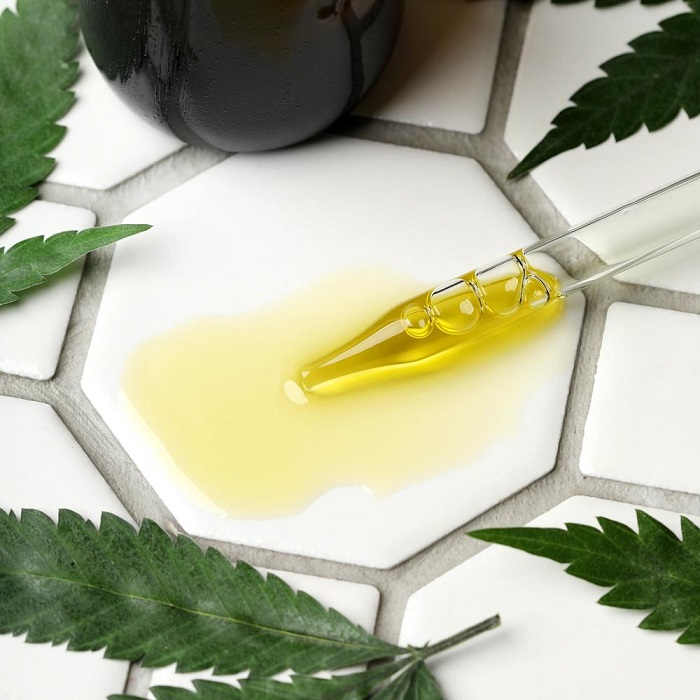
There is a lot of noise in the CBD industry with many companies claiming their form of CBD is better than their competitors. The best form of CBD is the one that you will use. CBD that sits in the container unused because of the taste, texture, consumer experience, and preferences does no good at all to the consumer or the seller. There is a form of CBD that is right for everyone. Let’s go through a few of them.
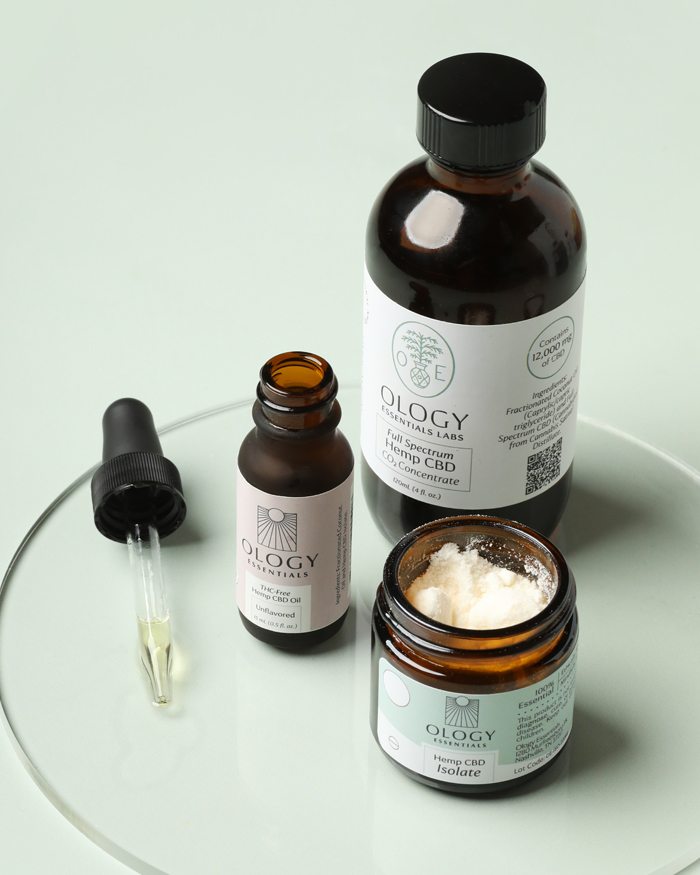
- Full Spectrum: Full spectrum means that the material has all the cannabinoids, terpenes, plant material, and chlorophyll that was in the hemp plant. Full spectrum can be produced through CO2 extraction or solvent extraction to produce a distillate. This distillate requires further processing to fall below the 0.3% THC level. Ology Essentials carries a CO2 Full Spectrum Concentrate that allows you to get high levels of full spectrum CBD into your formulations.
- CBD Isolate: The isolate is available as CBD Isolate Crystal and CBD Isolate Oil on the market place. Isolates contain only the isolated material–in this case CBD and all the other cannabinoids, terpenes, and plant material have been removed. The isolate crystal generally contains 99.5-99.9% CBD. A CBD isolate oil already has the CBD solubilized into a carrier oil.
- Broad Spectrum: Broad Spectrum means that the THC has been removed from the product but all the other cannabinoids, terpenes, plant material, and chlorophyll that was in the hemp plant are still intact.
- Water soluble CBD: CBD is oil soluble by nature. The water soluble versions generally use an encapsulation ingredient or process and often contain some sort of thickener to cause the CBD to be suspended in water.
When sourcing CBD look for companies that believe in transparency and readily share the Certificate of Analysis of their product. We prefer CBD that has been CO2 extracted over solvent extracted simply because it is the cleanest form of extraction.
How to incorporate CBD into skincare products
The metric system is the way to go when you are formulating with hemp CBD because for every product you develop you want to determine the milligrams of CBD per milliliter of the finished product.
With hemp CBD products, add a new section to your front label that displays the mg/mL of the finished product. We also recommend a QR code on the package that allows customers to review the Certificate of Analysis (COA) of that product. Full transparency gives consumers much more faith in your product in this industry.
Fat, heat, and math are the keys to successfully adding CBD to your formulas. There is a CBD Calculator for you to use on Ologyessentialslabs.com.
When formulating with full spectrum CBD there needs to be a fat in your formula and a hot phase. CBD isolate crystal is also fat soluble, but will dissolve in alcohol.
If you want to add CBD to one of your existing formulas you would first determine how much CBD you need to add to your product in the packaging size that you sell it in. Once you have made that decision head on over to Ology Essentials Labs to use the CBD Calculator to determine how much CBD needs to be added to your formula. That amount then needs to be removed from the oil content of your formula.
Original formula
- 25 grams beeswax
- 74 grams carrier oils
- 1 gram essential oils
And the calculator tells you that you need to add 2 grams of CBD to get the mg per mL that you want. Your new formula will be:
New formula
- 25 grams beeswax
- 72 grams carrier oils
- 2 grams CBD Concentrate
- 1 gram essential oils
An important little insider tidbit of information: all of the COA reports on CBD have a 10% over or under margin of error. For that reason it is always wise to formulate 10% over so that no matter what you always get the minimum amount listed on the front panel of your label. It is better to be over than under.
Heat is needed to dissolve both CBD isolate and any CBD distillate or concentrate into a fat. The melting point of CBD is 160-180 °F (71-82 °C). Many Makers just give this a stir and call it good, but we want to teach you how to do it right.
CBD needs to be homogenized into the oil or it can fall out of solution and create hot spots with high concentrations and cold spots with low concentrations. We want your products to work every time. You can homogenize your product using a high shear mixer.
When you manufacture products with any form of CBD in it, always make sure to protect the product from light and air. CBD is susceptible to oxidation that will cause your product to turn pink. We love pink, but it is disconcerting to consumers if they purchase a white or clear product that turns pink over time.
Usage rate for different products
Lip
Lip products tend to be itty bitty and a small portion is used each time. A good rule of thumb is to use two milligrams of CBD to each gram of lip product. Bramble Berry’s Hemp Lip Balm Base with Ology Essentials CO2 Full Spectrum Concentrate and filled it into Bramble Berry’s 0.3 oz Kraft Paperboard Tube for a product that would be 20 mg/9.35 g results in 2 g of full spectrum concentrate to 94 g of lip balm base.
Face
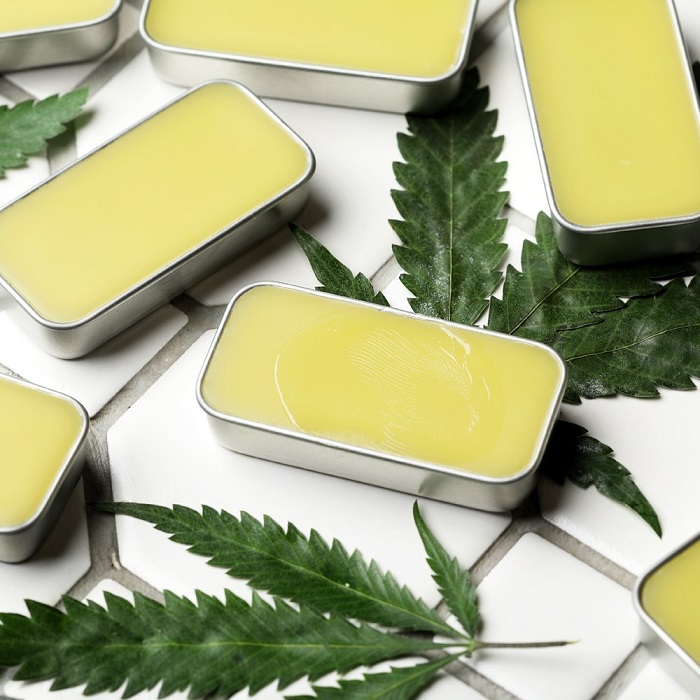
The CBD level in facial products on the market can range significantly from a sneeze worth of CBD to really high levels in a product. We prefer to land in the 2:1 to 3:1 ratio because facial products are often layered and with each layer, more CBD is being applied. The following formula using Bramble Berry Hemp Lotion Base creates a product that is 400 mg/120 mL. We like this lotion for adding CBD because it can be gently warmed. Your CBD should be added in a hot phase and this base allows anyone to become a kitchen chemist! The final recipe was 191.4 g of lotion base to 6.6 g of full spectrum concentrate.
Body
The amount of CBD in body products does not need to necessarily be high because you are dosing the whole body. The exception would be for a balm or salve that is generally going to be used in a localized area. For a whole body application a 2:1 to 4:1 ratio can be a great target. For a localized product the range could be as low 2:1 up to 20:1. A great example is the Ology Essentials Vitality Ointment 420 mg/25 grams. It was formulated out of need when a 3:1 product was not doing the trick. This formula was increased to approximately 16:1. In a balm recipe, a CBD ratio of 15:1 would be 450 mg/30 grams. That means that 67.15 g of carrier oil was used to 14.85 g of full spectrum concentrate. The remaining weight of the salve was beeswax and essential oils.
Bath
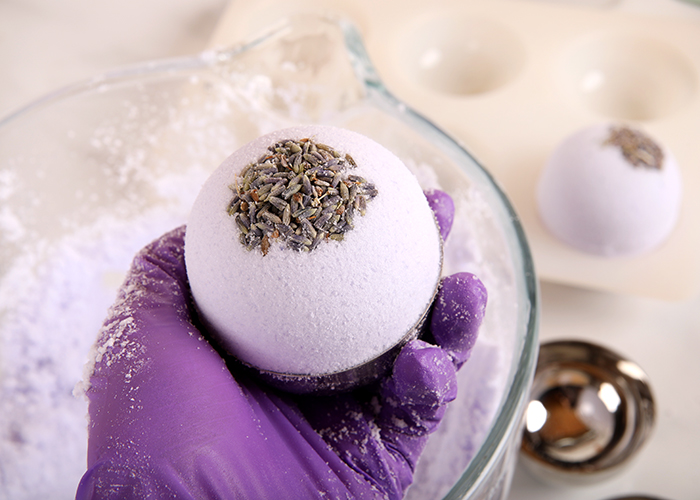
A bath is a favorite way to enjoy the benefits of hemp CBD because you sit in the product for a long time and the bath distributes it from head to toe plus the heat brings everything up a notch. A 2:1 to 4:1 ratio makes a nice bath product. In a bath salts recipe at 3:1, that means 3 g of full spectrum concentrate with 2 g of essential oil and 93 g of salts.
The most effective products for topical hemp CBD products are leave-on products such as a lotion, cream, salve, ointment, or spray. There is not a lot of value in adding CBD to a wash off product.
CBD in soap
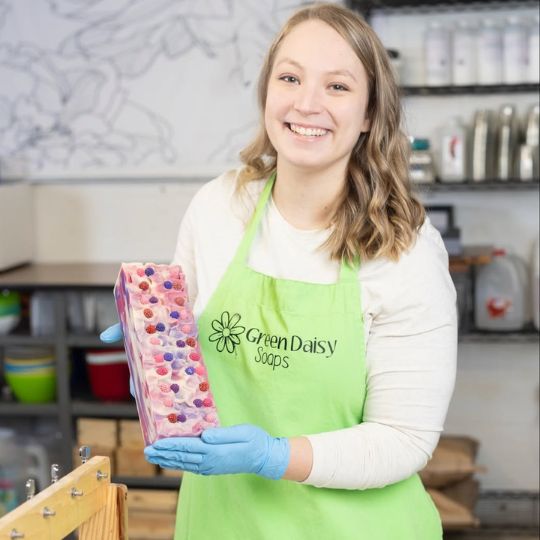
When you add CBD to soap the CBD reacts with lye to produce the sodium salt of CBD, which is water soluble, not fat soluble, which gives the CBD an even lower chance of absorption through the skin. In addition CBD reacts almost immediately with the lye to produce a bright purple color. CBD could be added to a melt and pour base to avoid the conversion to CBD salt.
Selling CBD products (regulations, labeling, etc)
So here is the rub…
There is a fine line between drugs and cosmetics. And every country had different regulations. In the US, topical usage of hemp CBD firmly falls in the cosmetic category of the FDA. The FDA has authority over cosmetics in the United States and the intended use of a cosmetic determines whether it falls under a cosmetic or a drug.
Claims that are made on the packaging, on social media, websites, consumer reviews, or any advertising that can sway what the consumer believes the product will do can change what the FDA views as the intended use of a product.
The FTC also has a say on claims so make sure that you are aware of the rules of the regulating bodies in whatever country you do business in. It is great to know all the properties of hemp CBD as you formulate products, but be careful about how you use that information in your marketing.
Business Hurdles for CBD
Hurdles in the CBD industry still exist, but they have been significantly lowered over the past few years.
- Banking - If you are considering adding CBD to your product line, make sure your bank is okay with that. If they are not, and you want to be in the industry, find another bank.
- Credit Card Processing - Not all credit card processors allow CBD. Currently PayPal and Stripe do not, but Square has a special program for hemp CBD. Check with your credit card processor before you launch.
- Insurance - CBD also impacts insurance. You can now get a reasonable insurance policy that covers hemp CBD products through Veracity with Indie Business Network and the Handcrafted Soap and Cosmetic Guild. Or you can avoid this hurdle by using a company that does private label and will add you to their insurance policy.
- Shadowbanning - Facebook and Instagram shadow ban for promoting hemp CBD. And TikTok simply removes anything they deem hemp CBD related. It is a careful dance.
- Platforms - Make sure that whatever platform you use to sell products allows hemp CBD. Some retailers report using WordPress with no issues today. CBD is banned on Amazon, Faire, and Etsy. If you have a Shopify site, take some additional steps with them and you can only use DigiPay, Pinwheel, and Authorize.net for your credit card processing.
Whether you choose to make products for personal use, gifts, or enter the marketplace with hemp CBD there are endless possibilities. Join the fun!
Disclaimer: This video was made for informational purposes. To manufacture for resale we recommend that you wear a hairnet, gloves, and lab coat or apron whenever manufacturing products for resale.

Additives Tags: